A term sheet is signed. Both sides shake hands, figuratively or literally, and everyone assumes the deal is now a formality. Then, six weeks later, the transaction stalls: a due diligence finding nobody flagged, a shareholder resolution nobody scheduled, a regulatory filing nobody knew was mandatory. This is one of the most common and most expensive mistakes foreign investors make when pursuing Mergers and Acquisitions in Indonesia: treating the legal process as a formality instead of the structure that actually determines whether a deal closes on time, or at all.
This guide walks through the complete legal process for M&A transactions in Indonesia, from the first Letter of Intent to the final post-closing filing, so that founders, corporate development teams, and legal counsel know exactly what happens at each stage, how long it typically takes, and where deals most often go wrong.
Why M&A Deals in Indonesia Stall (and How to Avoid It)
Indonesia remains one of Southeast Asia’s most active M&A markets, driven by consumer growth, digital transformation, and continued interest from regional and global strategic buyers. But the legal and regulatory framework layers several requirements that are unfamiliar to foreign acquirers used to more streamlined jurisdictions.
In practice, three issues account for most delays in Indonesian M&A transactions:
- Underestimating corporate approval requirements.A share or asset transfer often requires a formal shareholders’ resolution (RUPS) before it can proceed — not just board sign-off.
- Treating due diligence as a checkbox.Land title irregularities, unreported tax liabilities, and undocumented employment arrangements are common findings that reshape deal terms late in the process.
- Missing the mandatory competition filing.Failing to notify Indonesia’s competition authority (KPPU) within the statutory window can trigger administrative fines, regardless of how clean the underlying transaction was.
Understanding the sequence below is the single most effective way to keep a transaction — and its timeline — under control.
The Complete M&A Legal Process in Indonesia
Here is the diagram we’ll use, and refer back to, throughout this guide.
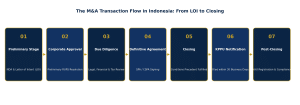
Step 1: Preliminary Stage — NDA and Letter of Intent (LOI)
Before any confidential information changes hands, the parties sign a Non-Disclosure Agreement (NDA). This is followed by a Letter of Intent (LOI) or Memorandum of Understanding (MOU), which sets out the proposed structure (share deal or asset deal), indicative valuation, exclusivity period, and the conditions that must be satisfied before a binding agreement is signed.
Key point: an LOI in Indonesia can inadvertently create binding obligations if drafted carelessly. Clauses on exclusivity, break fees, and confidentiality are typically intended to be binding even while the rest of the LOI remains non-binding — this distinction should be explicit, not assumed.
Step 2: Preliminary Corporate Approval (RUPS)
Under Indonesia’s Company Law (Law No. 40 of 2007, as amended), a transfer of shares representing a change of control, or a merger, consolidation, or acquisition, generally requires approval from the General Meeting of Shareholders (Rapat Umum Pemegang Saham, or RUPS).
At this early stage, the target company typically convenes a preliminary RUPS to formally authorize management to proceed with negotiations and due diligence, and — where relevant, to approve the waiver of existing shareholders’ pre-emptive rights. Quorum and voting thresholds vary depending on whether the transaction is classified as a merger, consolidation, or a straightforward share acquisition, so this should be confirmed against the target’s Articles of Association before scheduling.
Related Article
Step 3: Due Diligence — Legal, Financial, and Tax
With authorization in place, the buyer’s advisors conduct a comprehensive due diligence review covering:
- Legal due diligence: corporate legality, licensing (NIB/OSS-RBA), material contracts, litigation history, land and asset titles, intellectual property, and labor compliance.
- Financial due diligence: historical financial statements, working capital position, contingent liabilities, and related-party transactions.
- Tax due diligence: outstanding tax obligations, transfer pricing exposure, and unreported liabilities that could survive the transaction under Indonesian tax succession rules.
This stage typically takes four to eight weeks and directly shapes the representations, warranties, and indemnities that will appear in the definitive agreement. Findings here are the leading cause of valuation adjustments and deal delays — thorough due diligence up front is consistently cheaper than a dispute after closing.
Step 4: Negotiating and Signing the Definitive Agreement
Once due diligence findings are addressed, the parties negotiate and sign the definitive agreement — typically a Sale and Purchase Agreement (SPA) or Conditional Sale and Purchase Agreement (CSPA) if certain conditions (such as regulatory clearance or final RUPS approval) remain outstanding.
This document sets out the final purchase price and adjustment mechanism, representations and warranties, indemnification caps and survival periods, conditions precedent to closing, and — critically for cross-border deals — the governing law and dispute resolution forum (commonly Indonesian law with arbitration under BANI or SIAC, depending on the parties’ preference).
Related Article : Post-Closing Obligations After a Company Acquisition in Indonesia
Step 5: Closing
Closing occurs once all conditions precedent have been satisfied: final shareholder approval, any required third-party consents (such as lender or landlord consent), and — for foreign investment transactions, confirmation that the sector is open to the intended level of foreign ownership under Indonesia’s Positive Investment List (Daftar Positif Investasi).
At closing, the deed of share transfer is executed before a notary, the purchase price is released (often through an escrow arrangement), and the company’s shareholder register and Articles of Association are updated to reflect the new ownership structure.
Step 6: KPPU Merger Notification
If the transaction meets the asset or turnover thresholds set by Indonesia’s Business Competition Supervisory Commission (KPPU), a mandatory post-closing notification must be filed within 30 business days of the date the transaction becomes legally effective. This is a notification regime, not a pre-closing approval requirement, but missing the deadline exposes the parties to administrative fines regardless of whether the underlying transaction raises any competition concerns.
Foreign investors frequently assume this obligation only applies to large strategic mergers. In practice, the thresholds can capture mid-sized transactions as well, which is why threshold analysis should happen during due diligence, not after the notification deadline has already passed.
Step 7: Post-Closing Compliance
The transaction is not finished at closing. Post-closing steps typically include:
- Registering the amended Articles of Association and updated shareholder composition with the Ministry of Law and Human Rights (AHU).
- Updating the company’s business licensing (NIB) and any sector-specific permits through OSS-RBA to reflect the new shareholder structure.
- Filing the KPPU notification, if applicable, within the 30-business-day window.
- Addressing employee transition matters, including any changes to employment agreements required under the transaction structure.
- Fulfilling any post-closing tax reporting or restructuring steps agreed in the definitive agreement.
Timeline at a Glance
| Stage | What Happens | Typical Duration |
| Preliminary | NDA, LOI/MOU, preliminary RUPS resolution | 2–4 weeks |
| Due Diligence | Legal, financial, tax, and operational review | 4–8 weeks |
| Documentation | Negotiating and signing the SPA/CSPA | 3–6 weeks |
| Closing | Conditions precedent fulfilled, funds and shares transferred | 1–3 weeks |
| Regulatory | KPPU notification, AHU registration, licensing updates | 30–60 business days (parallel/post-closing) |
Actual timelines vary significantly depending on deal complexity, the number of regulatory approvals required, and how quickly due diligence findings are resolved. A straightforward domestic share acquisition can close in three to four months; a cross-border transaction involving a restricted sector under the Positive Investment List can take considerably longer.
Common Legal Pitfalls for Foreign Investors
- Assuming board approval is sufficient. Many change-of-control transactions legally require RUPS approval, not just board sign-off — proceeding without it can render the transfer void.
- Overlooking sector restrictions. Some sectors remain closed or partially restricted to foreign ownership; this must be confirmed before structuring the deal, not during closing.
- Underestimating land and asset title risk. Indonesian land titling can involve informal arrangements that only surface during a proper legal due diligence review.
- Missing the KPPU notification deadline. The 30-business-day clock starts from legal effectiveness, not from when the parties “feel” the deal is done.
- Using a generic, non-Indonesian-law template. Definitive agreements drafted for other jurisdictions frequently miss Indonesia-specific protections around indemnification, notarial requirements, and dispute resolution enforceability.
Why Experienced Indonesian Legal Counsel Matters
Every step above involves a regulatory or corporate law requirement that is specific to Indonesia, and most of them are not optional formalities that can be handled after the fact. A missed RUPS resolution can unwind a share transfer. A missed KPPU filing can trigger fines years after closing. A due diligence gap can turn into a warranty claim once the buyer is already the legal owner.
This is precisely where engaging Indonesian corporate counsel early, ideally before the LOI is signed, not after due diligence uncovers a problem, changes the outcome of a transaction. At WNP Asia, our corporate and M&A practice supports foreign investors, private equity sponsors, and corporate buyers through every stage of this process: structuring the transaction, leading legal due diligence, drafting and negotiating the SPA/CSPA, coordinating the RUPS and AHU filings, and managing the KPPU notification to keep the deal compliant from LOI to closing and beyond.